

Do Motorcycle Dash Cams Record Audio? Wind, Consent & What to Expect
You get home from a ride where a driver swerved into your lane, screen-recorded the clip to send to your insurer, and hit play expecting to hear the car's horn and your own shout — and instead it is a wall of wind. That roar is the single most common surprise riders run into the first time they check dash-cam audio. Yes, some motorcycle dash cams do record sound — Aoocci's C6 Pro, for example, captures synchronized audio with the video — but on a moving bike wind noise usually drowns out anything useful, and in some places recording audio adds a consent-law wrinkle, so plenty of riders leave it off and treat the video as the real evidence. Below we walk through why the physics fight you, when audio is still worth having, the legal side to check, and whether to switch it on at all.
Key takeaways
- Some moto cams do record audio. A camera with a built-in mic (like our C6 Pro, which lists "Synchronized Audio & Video") captures sound alongside the footage — but a mic on a bike is fighting open airflow a car's mic never sees.
- Wind is the problem, not the mic. At 40–70 mph there is no quiet cabin around you, so the mic mostly hears air rushing past — useful audio is the exception, not the rule.
- Audio is most useful at low speed and after a stop — a parked confrontation, an exchange of details, or a quick voice note — not at highway pace.
- There is a legal layer. Some US states and other countries treat recording conversations as a consent issue, so check your local law before relying on the audio.
- The video is your evidence; audio is a bonus. Most riders treat it that way, and many disable it. Aoocci builds dash cams and displays — not helmet intercoms — so for clear two-way speech, that is a different tool.
Why wind wrecks audio on a bike
A car dash cam sits inside a sealed cabin. Roll the windows up and the mic hears the driver, the passenger, the stereo — a reasonably quiet room moving down the road. A motorcycle has none of that. You are out in open air, and so is the camera, which means the mic picks up the airflow streaming past the bike at speed. By the time you are at a steady 40–70 mph, that rush of air is loud and broadband, and it sits right on top of whatever you actually wanted to capture — a horn, a shout, the other driver's words.
It is not that the microphone is weak. It is that a mic in moving air has no good way to separate the signal you care about from the wind energy hitting it, and a helmet does not help — your own breathing and the buffeting around your head add to the noise. Foam wind-screens and clever filtering reduce it on the best units, but they do not turn a 70-mph slipstream into a quiet room. We would rather you go in expecting marginal audio at speed than be disappointed after your first incident. So: a mic on a motorcycle cam can record sound, but treat highway-speed audio as a long shot rather than something you can lean on.
When audio is actually useful
The flip side is that audio is not useless — it just earns its keep below highway speed, where the wind quiets down. The moments where a mic genuinely helps tend to look like this:
- Low-speed and stop-and-go. Crawling through a parking lot, a tight intersection, or city traffic, there is far less airflow over the mic, so a nearby horn or a raised voice can come through.
- The aftermath of an incident. Once you have pulled over and the bike is stopped, the camera can still be rolling. An exchange of words, an admission, a witness saying what they saw — that is often the audio that matters, and it is captured at zero speed.
- Voice notes to yourself. Some riders narrate a plate number or a location into a still-running cam right after something happens, so the detail is on the clip while it is fresh.
None of that needs studio quality. It needs the mic to be on and the bike to be slow or stopped — which is exactly the window where the wind problem disappears.
The legal wrinkle: consent and audio
Video and audio are treated differently under the law, and audio is the touchier one. Recording the world around you on video is broadly accepted; recording a conversation can fall under wiretapping and consent rules. Under US federal law (18 U.S.C. §2511) the floor is one-party consent — your own presence counts — but states can be stricter, and roughly a dozen are. California, Florida, Illinois, Pennsylvania, Washington and several others are all-party (often called two-party) consent jurisdictions, where recording a private conversation without everyone's consent can be a violation. Outside the US, plenty of countries have their own rules.
For most ordinary riding this rarely bites — traffic and public road noise are not a private conversation. But the moment you are recording someone's words at close range, the picture changes, and the rules vary by where you are. We are a camera maker, not your lawyer, so treat this as a flag to check rather than legal advice: look up your own state or country before you count on the audio. This article is just the audio slice of the wider dash-cam legal picture.
Should you turn it on? An honest call
Here is how we would think about it. If you ride mostly at speed and your goal is evidence, the audio is rarely going to add to your case — the video already shows the lane positions, the closing speeds, the impact. Many riders, knowing both the wind reality and the consent question, simply leave audio off and never miss it.
If you spend real time in slow city riding, or you want the camera rolling through a roadside exchange after a near-miss, leaving audio on costs you almost nothing and occasionally captures something the video cannot. On a cam that records sound, it is typically a single toggle in the device's settings or companion app — on by default on some units, off by default on others, easy to flip either way. Our advice: decide based on where you ride, confirm your local law if you keep it on, and remember that the footage is the evidence and the audio is a bonus on top.
Audio on vs. off: how the trade-off shakes out
| Factor | Audio ON | Audio OFF |
|---|---|---|
| Evidence value at speed | Low — wind usually drowns it out | No loss — video carries the case |
| Evidence value parked / low speed | Can capture an exchange or admission | You lose that window entirely |
| Legal exposure | Possible consent issue in some places | None — video-only avoids the question |
| Storage | Slightly higher (audio adds a little) | Marginally more recording time per card |
| Who it suits | City riders, post-incident capture | Highway commuters wanting clean evidence |
What riders tell us
When riders bring up dash-cam audio, the recurring theme is being let down by it at speed — they expected to hear the incident and got mostly wind, so they stopped treating audio as part of the evidence. The riders who keep it on tend to be the ones who do a lot of low-speed and city miles, or who want the cam still listening when they pull over to swap details after a close call. Both camps land in the same place: the video is what proves the story, and the audio is a sometimes-helpful extra.
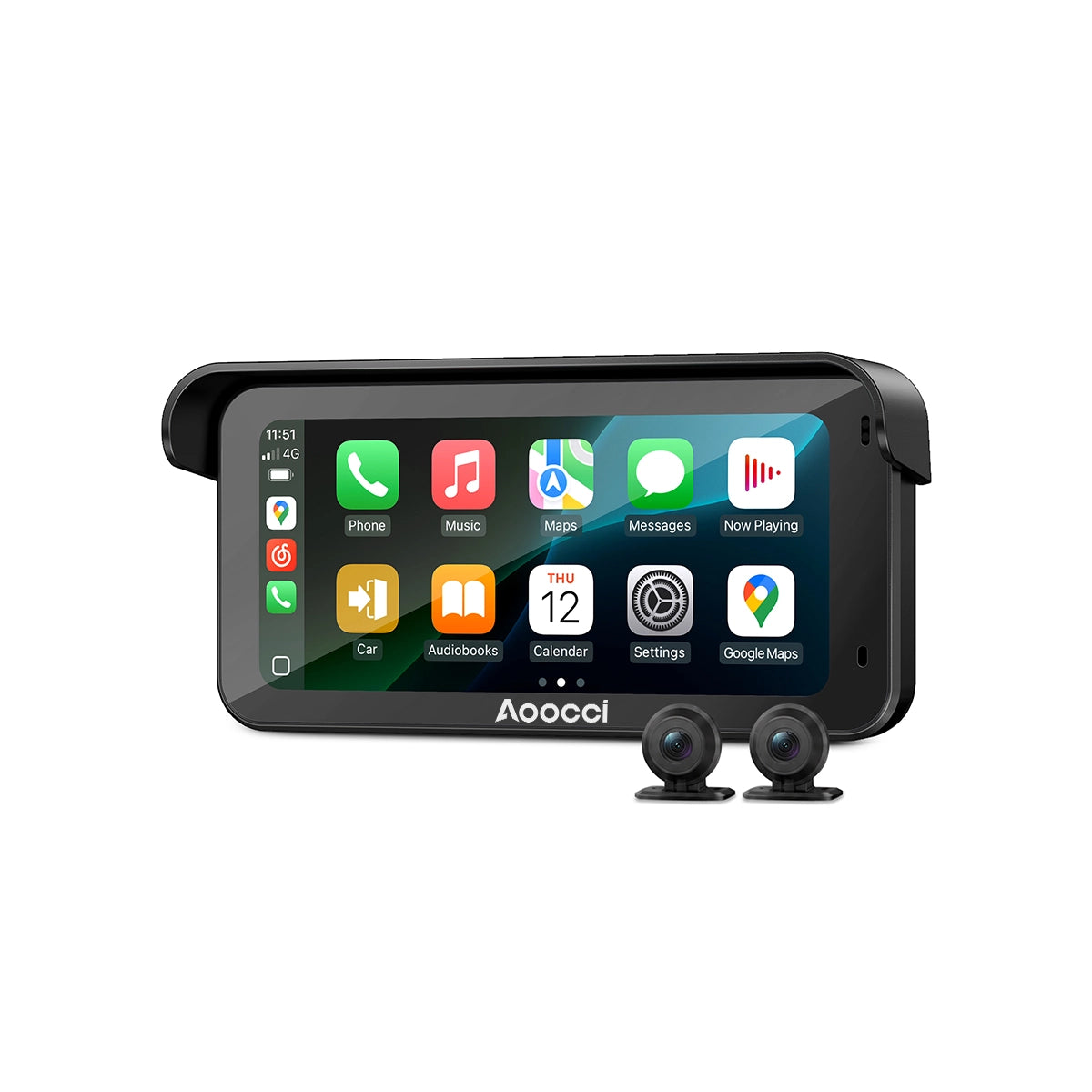
Aoocci C6 Pro — $289
An all-in-one motorcycle dash cam with dual AHD 1080p front-and-rear recording at 30fps, built-in GPS, a 3-axis emergency impact lock, anti-theft hardware, and an IP67 weather rating — and it is one of our cams that records synchronized audio alongside the video. Honest limit: like any bike-mounted mic, that audio fights wind noise at highway speed, so treat it as a low-speed and post-stop bonus, not your primary evidence.
See the C6 Pro →To compare every recording-capable model in one place, browse our motorcycle dash cam collection. And for turning footage into something that actually holds up after a crash, our guide to whether dash cam footage is valid evidence in accidents walks through what makes a clip usable — including the part about recording it legally.
Frequently asked questions
Do motorcycle dash cams record sound?
Some do. A motorcycle dash cam records audio only if it has a built-in microphone and the feature is switched on — for example, our C6 Pro lists "Synchronized Audio & Video," so it captures sound with the footage. Not every cam includes a mic, and some that do ship with audio disabled by default, so check the spec sheet and the device settings rather than assuming.
Why is dash cam audio so windy on a bike?
Because a motorcycle has no enclosed cabin. Unlike a car, where the mic sits in a quiet sealed interior, a bike-mounted camera is out in open air, so at 40–70 mph the microphone mostly picks up the rush of airflow streaming past. That broadband wind noise sits on top of whatever you wanted to capture, which is why highway-speed audio is usually marginal even on a good mic.
Is it legal to record audio on a motorcycle dash cam?
It depends on where you are. Recording video is broadly accepted, but recording a conversation can fall under wiretapping and consent laws. US federal law sets a one-party-consent floor, but about a dozen states — including California, Florida, and Illinois — require all-party consent for private conversations, and other countries have their own rules. We are not lawyers, so check your local law before relying on the audio.
Should I turn dash cam audio on or off?
If you ride mostly at speed and want clean evidence, audio adds little because the video already documents the incident, and many riders leave it off. If you do a lot of low-speed or city riding, or want the cam still recording when you pull over to exchange details after a near-miss, leaving it on costs almost nothing and can occasionally capture something useful. Decide by where you ride, and confirm your local consent law if you keep it on.
Does recording audio use more storage?
A little, but not much. The audio track is small compared with the video stream, so turning it on shortens your card's recording time only marginally. The bigger storage drivers are resolution, frame rate, and whether you record front and rear — not the audio. If you are tight on space, dropping audio frees a small amount, but loop recording will overwrite the oldest footage long before audio is the limiting factor.