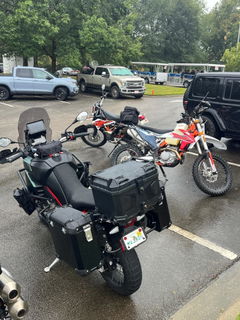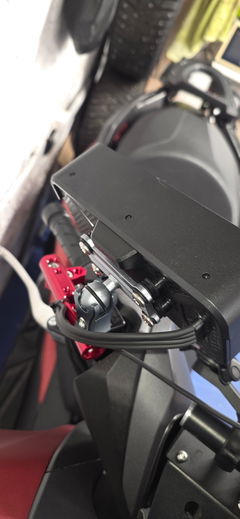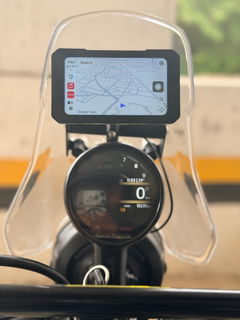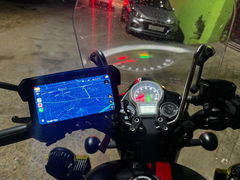


Know Which Side Needs Another Check
Add focused rear-side awareness for blind spots, overtaking, lane changes and fast rear approaches. A rear-mounted 60 GHz radar monitors up to 30 m across 130° horizontal coverage, while separate left and right indicators direct attention to the side that needs another check.
Millimeter-wave radar monitors rear-side traffic.
Engineering-confirmed maximum detection distance.
Horizontal detection coverage behind the motorcycle.
Range. Coverage. Closing-Risk Logic.
The radar monitors rear-side traffic within a defined distance and coverage area, then evaluates closing speed and estimated time to collision before directing the visual warning to the matching side.
Up to 30 m Detection
Monitors rear-side traffic at a maximum stated distance of 30 m.
≥10 km/h Relative Speed
One warning condition is a rear target closing at least 10 km/h faster than the motorcycle.
Within 3 s
Another warning condition is an estimated time to collision within 3 s.
One Rear Radar. Two Clear Side Signals.
After the warning conditions are met, the rider-facing message stays simple: the corresponding left or right indicator flashes for the triggered side.

Rear-Mounted Radar
Installed centered, level and unobstructed at the rear of the motorcycle.
Left / Right Indicators
Mounted where the rider can see which side produced the warning.
Three Riding Situations. One Clear Visual Cue.
The warning system supports overtaking, lane-change and fast rear-approach awareness without taking the decision away from the rider. The corresponding-side indicator remains the cue to check mirrors, blind spots and surrounding traffic again.

AOA — Active Overtake Alert
Supports another rear-side check before you move back into a lane after overtaking.
LCA — Lane Change Assist
Provides a side-specific warning to prompt another mirror and shoulder check before changing lanes.
RCW — Rear Collision Warning
Warns of rear-closing traffic under the confirmed distance, relative-speed and time-to-collision conditions.
Automatic Light Adjustment
Indicator brightness adjusts automatically to ambient light as riding conditions change.
Give the Radar a Clear Rear View
Correct position and alignment matter. Confirm that the motorcycle has a clean, stable and unobstructed rear mounting area before installation.
Position and Alignment
- Mount the radar centered at the rear of the motorcycle.
- Keep it 50–100 cm above the ground.
- Make sure the housing mark “UP” faces upward.
- Keep the radar face vertical, level and aligned with the motorcycle.
Clear Detection Area
- Do not place metal plates, crash bars or cargo racks in front of the radar face.
- Keep the mounting surface flat, clean and stable.
- Recheck the area after luggage or accessories are fitted.
- Keep wiring away from heat, water ingress and pinch points.
Installation requires access to an ACC-switched circuit, vehicle ground and the left/right indicator wiring. Use a qualified installer if you are not experienced with motorcycle electrical systems.
Choose the Mount for the Motorcycle
3M Adhesive Mounting
Use the documented adhesive method only on a clean, flat and unobstructed mounting surface that can support the radar securely.
Screw Fastening
Use screw fastening for a long-term installation or where road vibration makes a more permanent mounting method appropriate.
IP67-Rated for Exposed Installation
The radar system is rated IP67 for an exposed rear mounting position. Keep connectors sealed and route the harness away from water-ingress points during installation.

What Comes in the Box
The kit includes the rear radar with bracket, two warning indicators, main harness, 3M pad, hex key, five cable ties and two mounting screws.

Product Specifications
These specifications cover the confirmed core configuration and the installation facts needed to plan a suitable retrofit.
Detection & Alerts
| Radar technology | 60 GHz millimeter-wave radar |
|---|---|
| Maximum detection distance | Up to 30 m |
| Horizontal coverage | 130° |
| Warning conditions | Rear target within 30 m, at least 10 km/h faster than the motorcycle, and estimated time to collision within 3 s |
| Warning output | Separate left and right visual indicators |
| Warning roles | Active Overtake Alert (AOA), Lane Change Assist (LCA), and Rear Collision Warning (RCW) |
| Indicator brightness | Automatic ambient-light adjustment |
| Water protection | IP67 |
Power & Installation
| Radar module voltage | 5 V |
|---|---|
| System input | 5–24 V DC |
| Recommended vehicle supply | 12 V DC regulated |
| Recommended radar position | Centered at the rear |
| Mounting height | 50–100 cm above the ground |
| Mounting methods | 3M adhesive or screw fastening |
| Power connection | ACC-switched hardwire |
Before You Install
How far does the radar monitor, and what triggers a warning?
It monitors rear-side traffic up to 30 m across a 130° horizontal area. Warning conditions include a rear target within 30 m, moving at least 10 km/h faster than the motorcycle, with an estimated time to collision within 3 s.
How do the left and right alerts work?
The indicator on the corresponding side flashes when that side triggers the warning, keeping left-side and right-side alerts separate. Indicator brightness adjusts automatically to ambient light.
Where should the radar be installed?
Install it centered at the rear, 50–100 cm above the ground, with the UP mark facing upward and the radar face level, vertical and free from metal parts, luggage or accessories that could obstruct detection.
How is the system powered?
The hardwired system accepts 5–24 V DC. The radar module operates at 5 V, and a regulated 12 V vehicle supply is recommended. It connects to ACC-switched positive and ground so it powers on with the motorcycle.
Does the system replace mirrors or shoulder checks?
No. This is a rider-assistance system. Keep using mirrors, shoulder checks, attention and judgment on every ride.
What do AOA, LCA and RCW cover?
AOA supports awareness before returning to a lane after overtaking, LCA supports another check before changing lanes, and RCW warns of fast rear-closing traffic. These alerts support rider awareness and do not replace observation or judgment.